

Introduction
At the same time I was becoming aware of ecological dynamics and adopting the Constraints-Led Approach (CLA), I realized that one of the biggest things I had struggled with for years wasn’t designing an activity—it was organizing an entire practice.
I understood the principles of CLA, but I still didn’t know how to put them together into a coherent practice. I felt like a stand-up comedian with a collection of five-minute bits trying to put together an hour-long special. The individual pieces worked, but there was no common thread, no bigger picture.
I didn't need better games. I needed a better way to organize them.
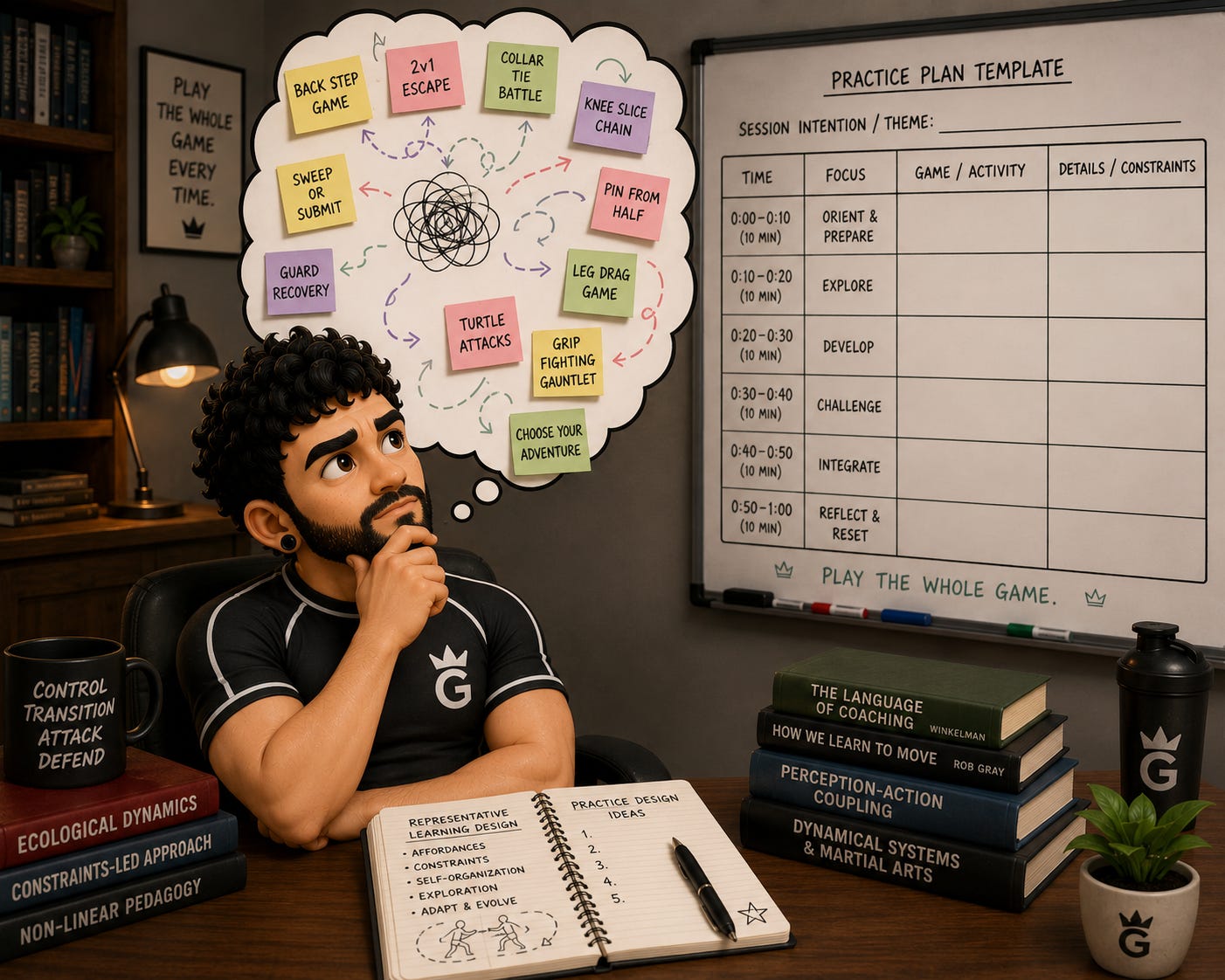
Since starting and participating daily in the ED4SG Discord community discussions, running two coaching camps, and applying these ideas in my own practices for the past few years, a handful of simple concepts have fundamentally changed how I design practices. None of them are complicated, but together they’ve made practice planning faster, more flexible, and far more representative of the game.
These are the five practice design ideas that had the biggest impact on how I design practices.
1. Design Time Before You Design Games
The first thing I plan isn’t the game—it’s the clock.
One of the biggest shifts in my coaching came during a visit to Standard Jiu-Jitsu with Greg Souders. I first heard Greg speak with Sonny Brown about the Constraints-Led Approach and what he was building at Standard Jiu-Jitsu. Not long afterward, I had the opportunity to drop into one of his practices.
About halfway through, I realized there was a pattern to everything we were doing.
Greg wasn’t just designing games. He was designing time.
To me, it seemed that instead of viewing a class as sixty continuous minutes, he divided it into repeatable blocks. Every block had a predictable rhythm.
After that visit, I started reading everything I could find about coaching and practice design, and I started coming across some things that aligned with what I had experienced. In the book, The Language of Coaching, Nick Winkelman describes two coaching communication loops: a long loop (DDCDD) and a short loop (CDD).
The long loop follows a simple rhythm: Describe → Demonstrate → Cue → Do → Debrief
The short loop removes the explanation and demonstration once players understand the activity: Cue → Do → Debrief
Combining Winkelman's communication loop with what I observed in Greg's practice led me to come up with a similar three-part block structure.
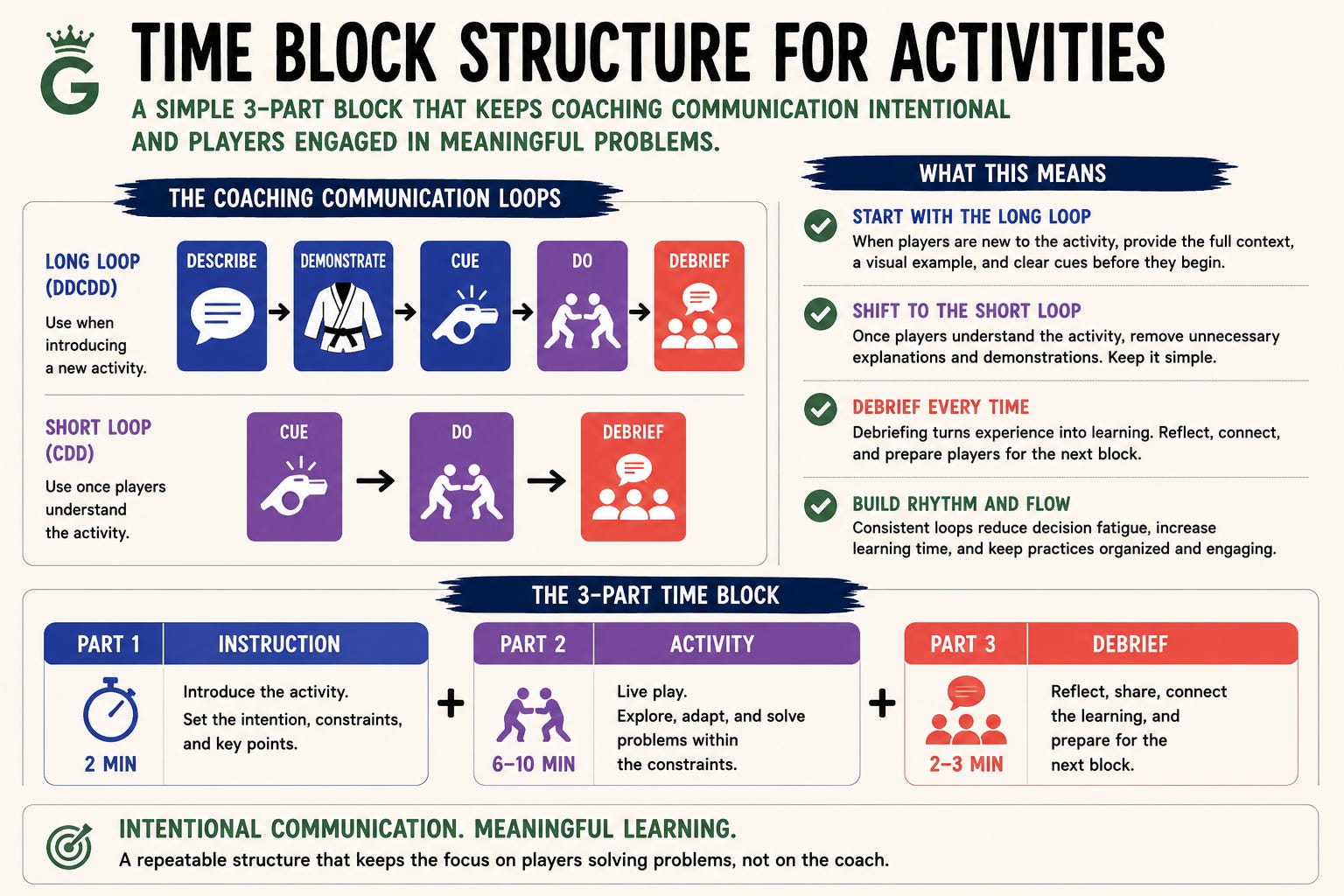
Rather than wondering how long I should explain something or when it was time to move on, every activity now places constraints on me as the coach. Those constraints forced me to become much more intentional about what information I shared, how I demonstrated it, and which cues I chose to emphasize.
Based on that time block structure, I came up with four standard activity blocks.
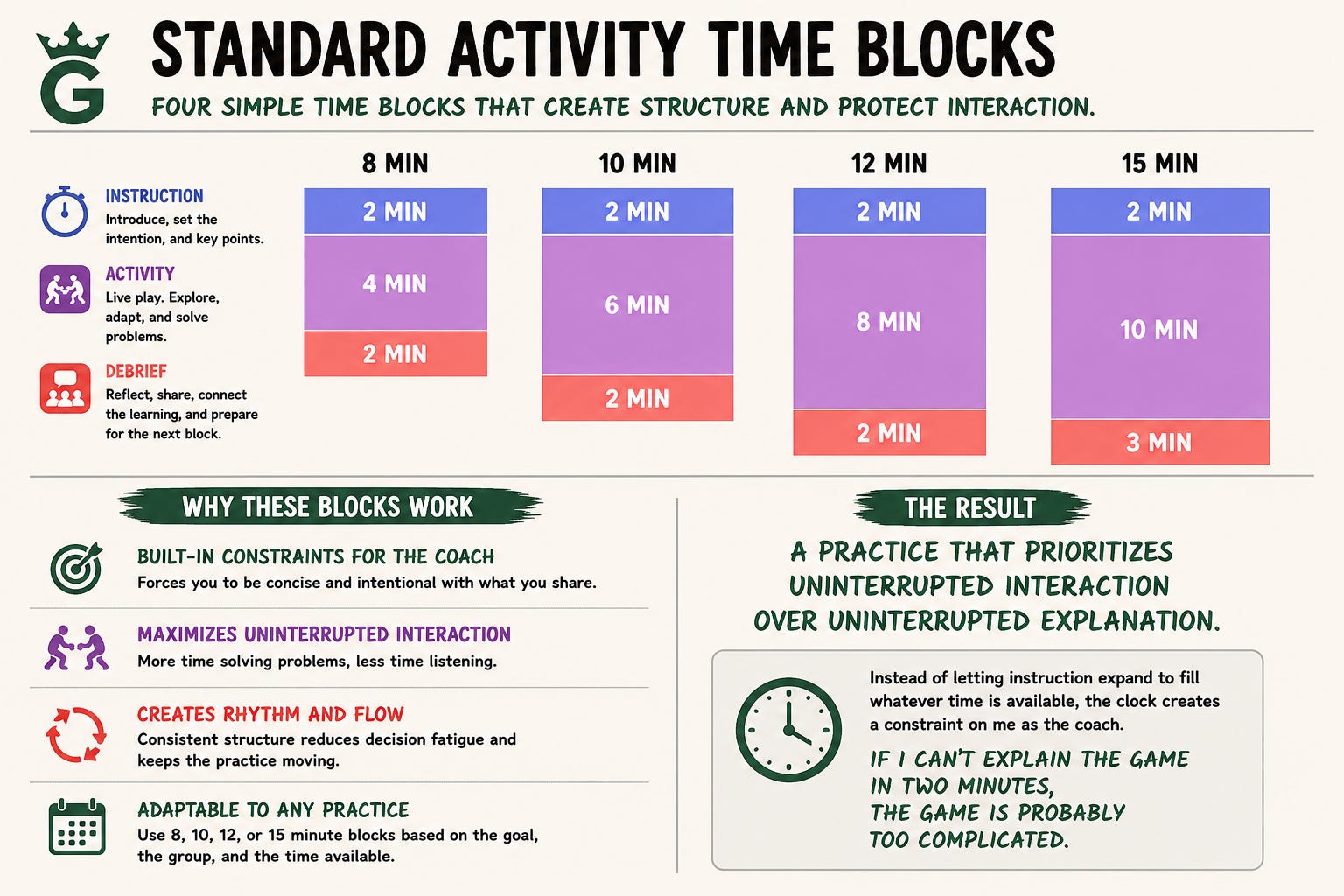
The result is a practice that prioritizes uninterrupted interaction over uninterrupted explanation. Instead of letting instruction expand to fill whatever time is available, the clock creates a constraint on me as the coach. If I can't explain the game in two minutes, the game is probably too complicated.
The biggest lesson wasn’t simply that players benefit from constraints. Coaches do too. By constraining my own time, I became more deliberate with my demonstrations, more concise with my instructions, and more willing to let the game do the teaching.
2. Build Practices with Modular Blocks
Once I started thinking about activities as timed blocks, another realization followed.
If every activity shared the same underlying structure, I no longer had to design sixty minutes of practice. I only had to decide how to arrange those blocks.
With trial and error, I ended up with a handful of reliable practice structures.
6×6
The simplest example is what I call 6×6. It consists of six 10-minute activity blocks arranged around a common theme or intention. Once the overall structure is established, the practice can still vary considerably by changing how those six blocks are distributed across the three major moments of the Game Model.
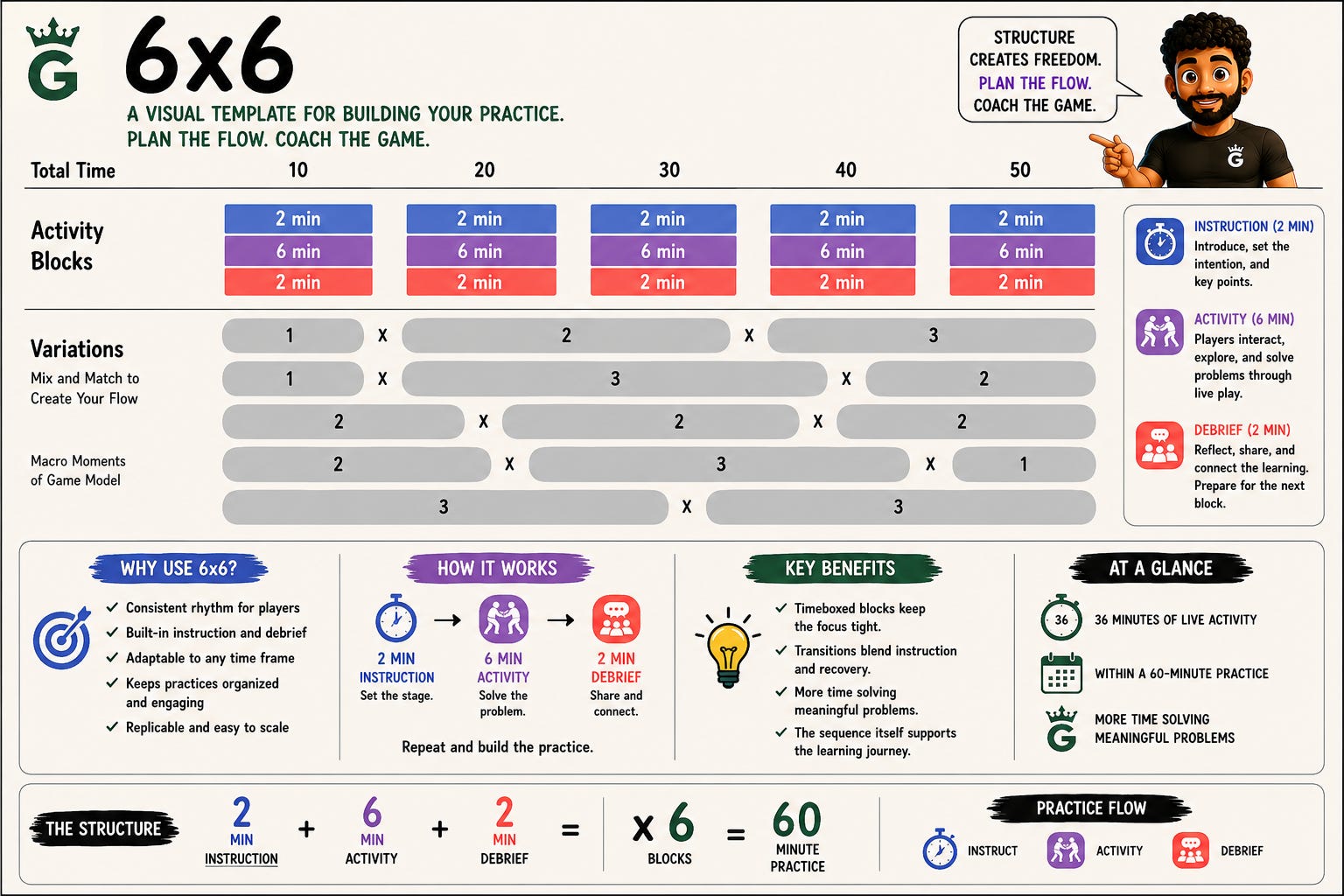
The numbers in each row represent the number of activity blocks devoted to Standing, Guard, and Pinning respectively. A 1–2–3 distribution might emphasize pinning, while a 2–3–1 distribution shifts more attention toward guard. The architecture of the practice stays exactly the same; only the emphasis changes.
This structure guarantees 36 minutes of uninterrupted live activity in a 60-minute class. In practice, however, the transition between blocks is rarely a complete stop. As players recover, I begin introducing the next activity, so the final minutes of one block naturally blend into the opening minutes of the next.
Depending on how quickly the group transitions, players typically spend 36–45 minutes engaged in representative learning activities—roughly 60–75% of the entire practice.
Dance with the Devil
Not every practice needs to distribute time evenly across multiple activities. Sometimes I want the sequence of the practice itself to become part of the learning experience.
One example is what I call Dance with the Devil.
The name comes from the layout of the practice: an opening Dance—a 12-minute block with 8 minutes of uninterrupted standing activity—followed by three 10-minute blocks, each containing 6 minutes of live activity (the “666”), before finishing with an extended whole-game round.
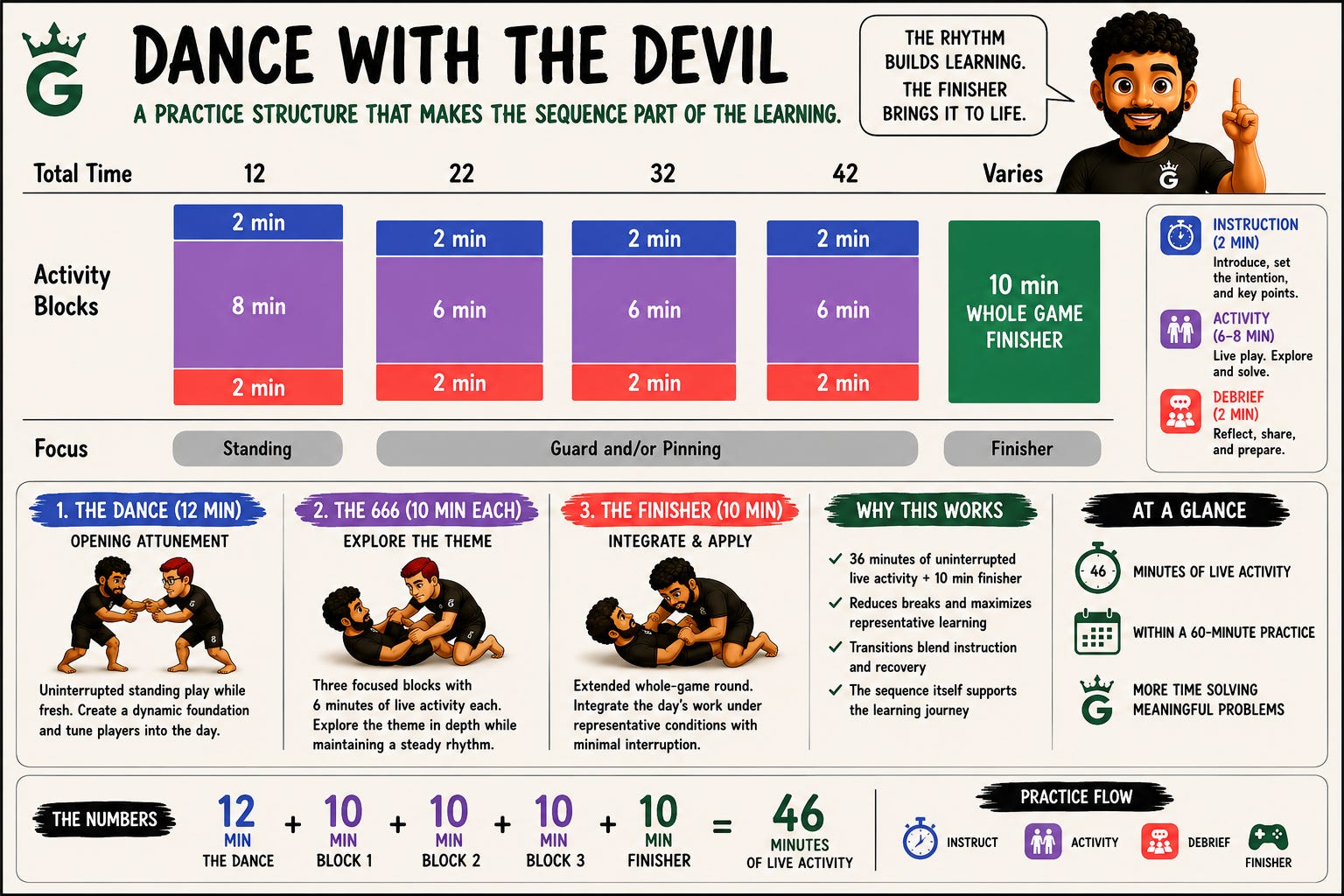
The opening standing block serves as an attunement phase. Players immediately begin solving problems in a highly dynamic environment while they’re fresh, creating a natural foundation for the more focused activities that follow.
The three middle blocks provide enough time to explore a specific theme or intention in greater detail while maintaining a steady rhythm throughout the class.
The practice concludes with a longer finishing round, giving players an opportunity to integrate the day’s work under representative conditions with minimal interruption.
This structure provides 36 minutes of uninterrupted live activity across the first four blocks, plus a 10-minute finisher, for a total of 46 minutes of representative learning within a 60-minute practice. As with the 6×6, the transitions between blocks naturally blend instruction and recovery, increasing the amount of time players spend interacting with meaningful problems.
Three Tens
Sometimes a single problem deserves more time than a six- or eight-minute activity block can provide. Rather than increasing the number of activities, I reduce them.
The 3×10s structure consists of three 15-minute activity blocks, each providing 10 minutes of uninterrupted live activity. Compared to the 6×6 or Dance with the Devil, players transition less frequently and spend more time immersed in each activity.
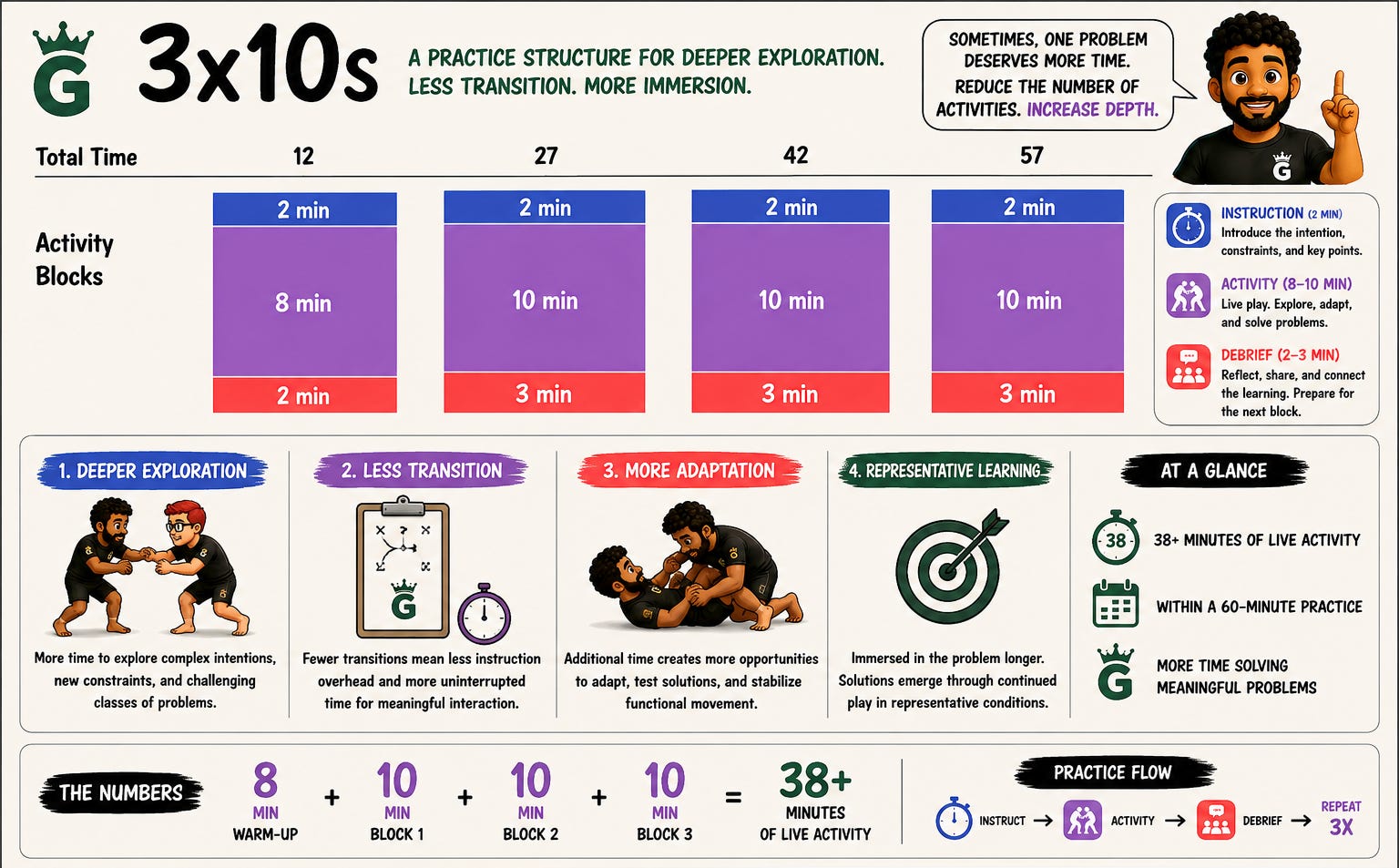
This format works particularly well when exploring more complex intentions, introducing new game constraints, or allowing players to repeatedly encounter the same class of problems without interruption. The additional time gives players more opportunities to adapt, explore, and stabilize functional solutions.
Fewer transitions also reduce the amount of instructional overhead. Rather than stopping every few minutes to introduce a new game, I can spend more time observing, making subtle adjustments to each group based on skill, and allowing learning to emerge through continued interaction.
The 3×10s structure provides 30 minutes of uninterrupted live activity across the three activity blocks. Combined with an 8-minute representative warm-up, players accumulate 38 minutes or more of live training within a 60-minute practice. As with the other structures, transitions between activities naturally overlap with instruction and recovery, often increasing the total amount of representative learning time.
Make It Your Own
The examples in this article aren't intended to be rigid templates. They're simply starting points that I've found useful in my own coaching. Adjust the length of the blocks, rearrange the sequence, combine elements from different structures, or create entirely new ones. The goal isn't to copy these formats exactly—it's to develop a repeatable practice architecture that fits your players, your environment, and your coaching philosophy.
3. Play the Whole Game Every Day
Another idea I adopted from Greg Souders was deceptively simple:
Play the whole game every day
Greg originally framed this as a solution to one of the biggest challenges facing most academies: attendance. Players don’t all train with the same frequency. Some are on the mats five days a week, while others only make it once or twice. If each class focuses exclusively on one area of grappling, students who attend inconsistently may go weeks without experiencing important parts of the game.
By ensuring every practice includes some combination of Standing, Guard, and Pinning, every player regularly encounters the major moments of submission grappling, regardless of how often they train.
For me, however, this idea became much more than an attendance solution.
This is also why I organize practices around major moments rather than positions. Every practice becomes an opportunity to experience the flow of the game instead of isolated fragments of it.
This perspective fit naturally into the Game Model I was building. Rather than organizing practices around techniques or disconnected positions, I began organizing them around the recurring interactions that define submission grappling. Whether I use a 6×6, Dance with the Devil, 3×10s, or another practice structure, each one allows me to intentionally distribute time across Standing, Guard, and Pinning while still emphasizing whatever theme or intention I want to explore that day.
Playing the whole game every day doesn’t mean every moment receives equal attention. Some practices may heavily emphasize standing, while others spend more time in guard or pinning. The goal isn’t balance for its own sake—it’s ensuring players repeatedly experience the complete landscape of the sport while allowing the emphasis to shift based on the needs of the day.
This also reflects an important principle of ecological dynamics: behavior emerges from the interaction between players, not from isolated techniques. Standing exchanges shape the opportunities that emerge in guard. Guard interactions influence passing and pinning. Pinning creates submissions, escapes, and scrambles that often return the interaction back to standing or guard.
When players regularly experience these transitions, they begin to perceive submission grappling as a continuous, interconnected game rather than a collection of separate positions to memorize.
4. The Block Is Stable—The Experience Isn’t
At this point, it’s fair to ask:
Doesn’t following the same practice structures every week become repetitive?
It could—if the variability stopped there.
The overall structure of the practice remains stable, but there are many other ways to create variability within each activity block. Rather than reinventing the architecture of every practice, I manipulate the constraints that shape the interactions taking place within it.
I rely on a three simple ways to introduce variability into an activity block without changing the overall practice structure.
Pairing Structures
One of the simplest ways to introduce variability without changing the activity itself is to change who interacts with whom.
Since submission grappling is ultimately performed player versus player, most coaches naturally default to 1 vs. 1 training with the same dedicated partner throughout an activity. While there’s nothing inherently wrong with this approach, it’s only one way to organize interactions.
Whether players work 1 vs. 1, in pods of three, pods of four, pods of five, Shark Tanks, or line rotations, each pairing structure shapes the learning environment differently. Some increase opportunities for observational learning. Others increase workload. Others expose players to a greater variety of opponents.
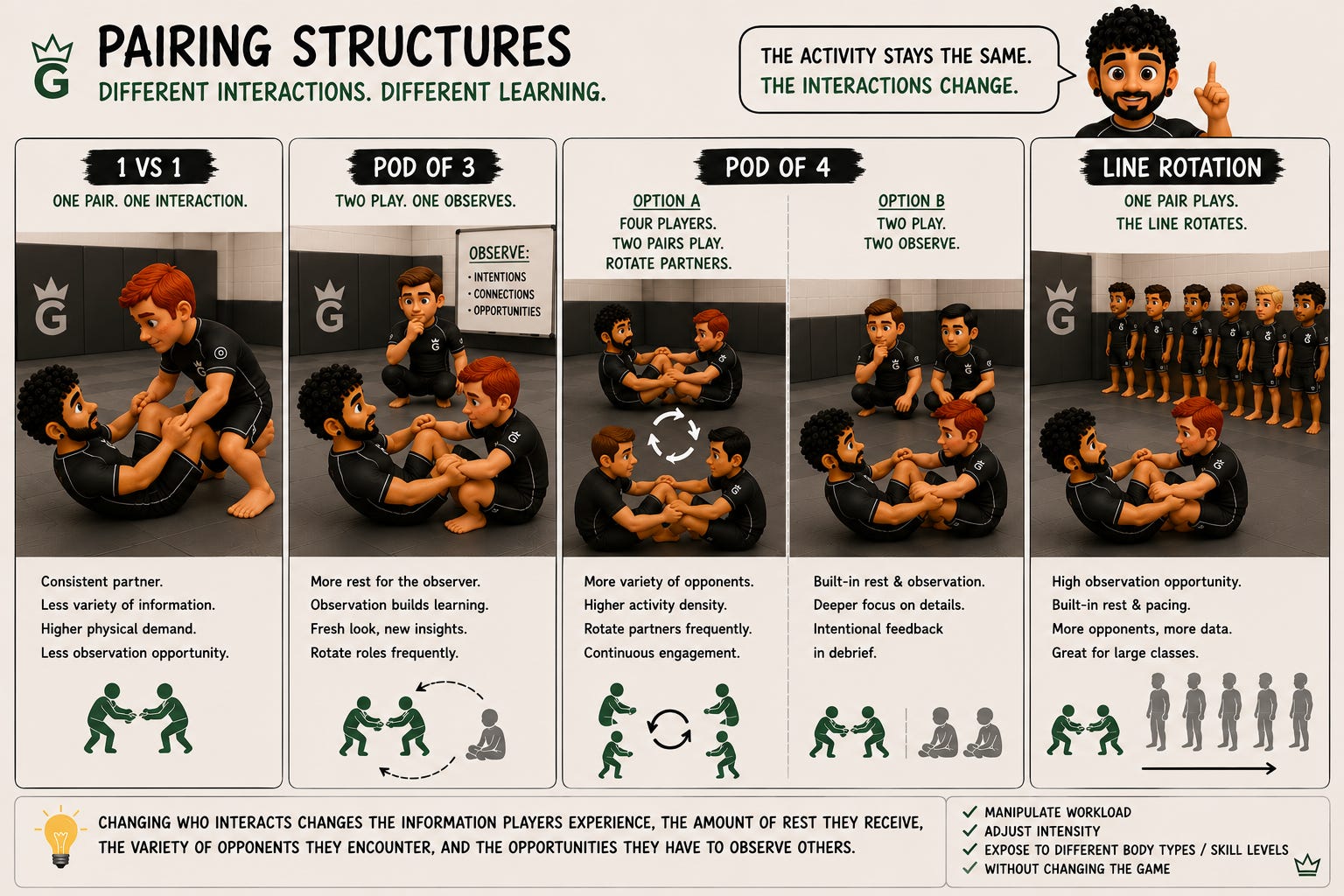
Changing who interacts with whom changes the learning environment without changing the activity itself.
Reset Conditions
Another simple way to introduce variability is to change how play resets.
Within terminal games, the reset condition fundamentally changes the tactical landscape. A game that resets only after a successful submission encourages different behaviors than one that resets after achieving a very specific condition(s), such as connected hands around the torso. Likewise, a winner-stays format promotes different strategies than rotating players after every round.
Whether you use winner stays, loser stays, alternating attempts, timed resets, progressive resets, or another reset condition, each influences how players manage effort, make decisions, and prioritize different aspects of the interaction.
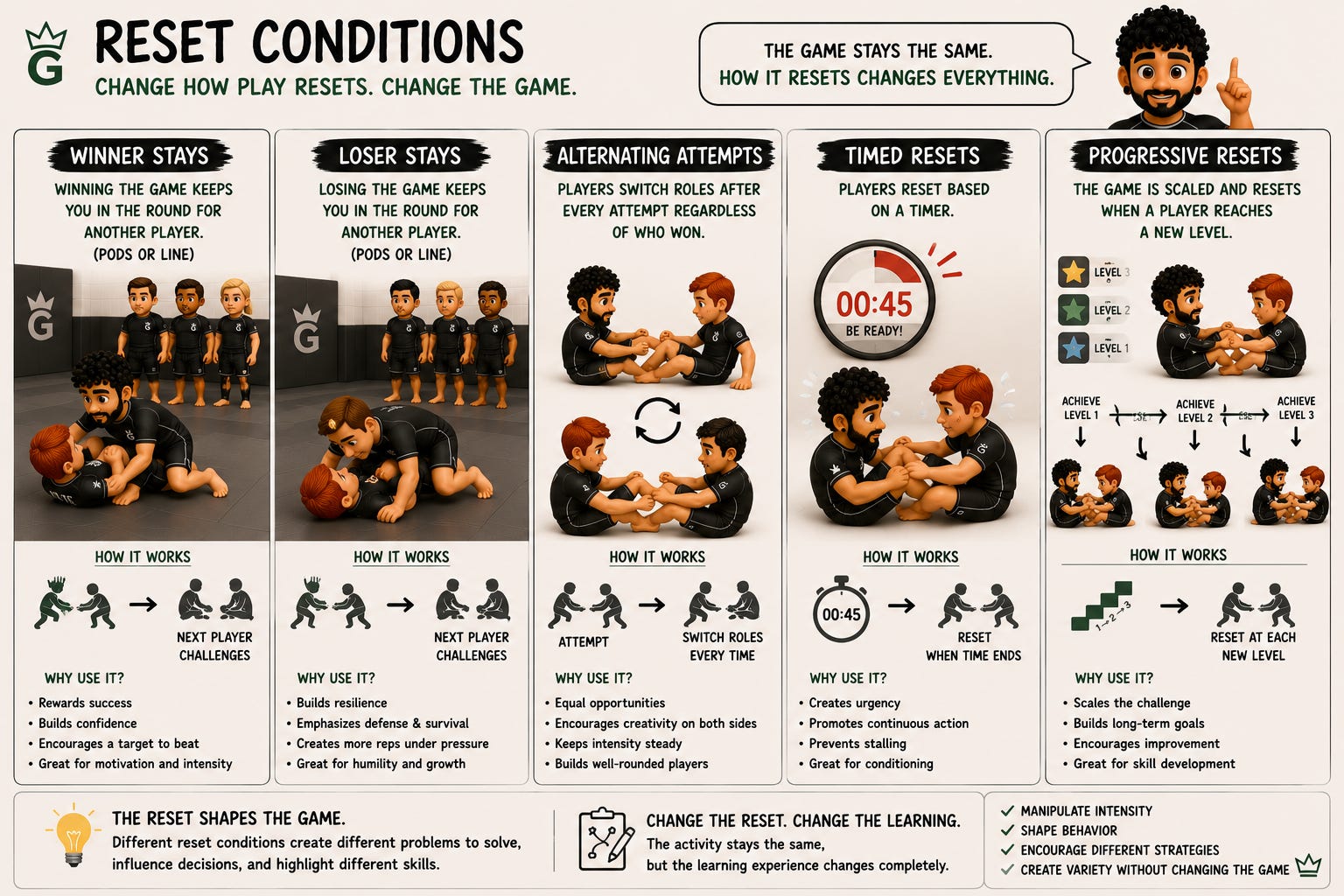
Together, pairing structures and reset conditions provide two simple ways to create meaningful variability without changing the game itself.
Entry Conditions
Another way to create variability is to change how an interaction begins.
Most grappling activities start from a static position. Players assume a predetermined configuration, wait for a signal, and begin solving the problem from there. While static starts are useful for isolating a specific situation or emphasizing a particular intention, they aren’t the only way to enter into an activity.
Alternatively, the same game can begin dynamically.
Players might start by hand fighting until reaching a checkpoint connection. They may have to earn the connection, create the necessary conditions, or transition naturally into the game through movement before the primary objective begins. Rather than being placed into the problem, they must first navigate their way into it.
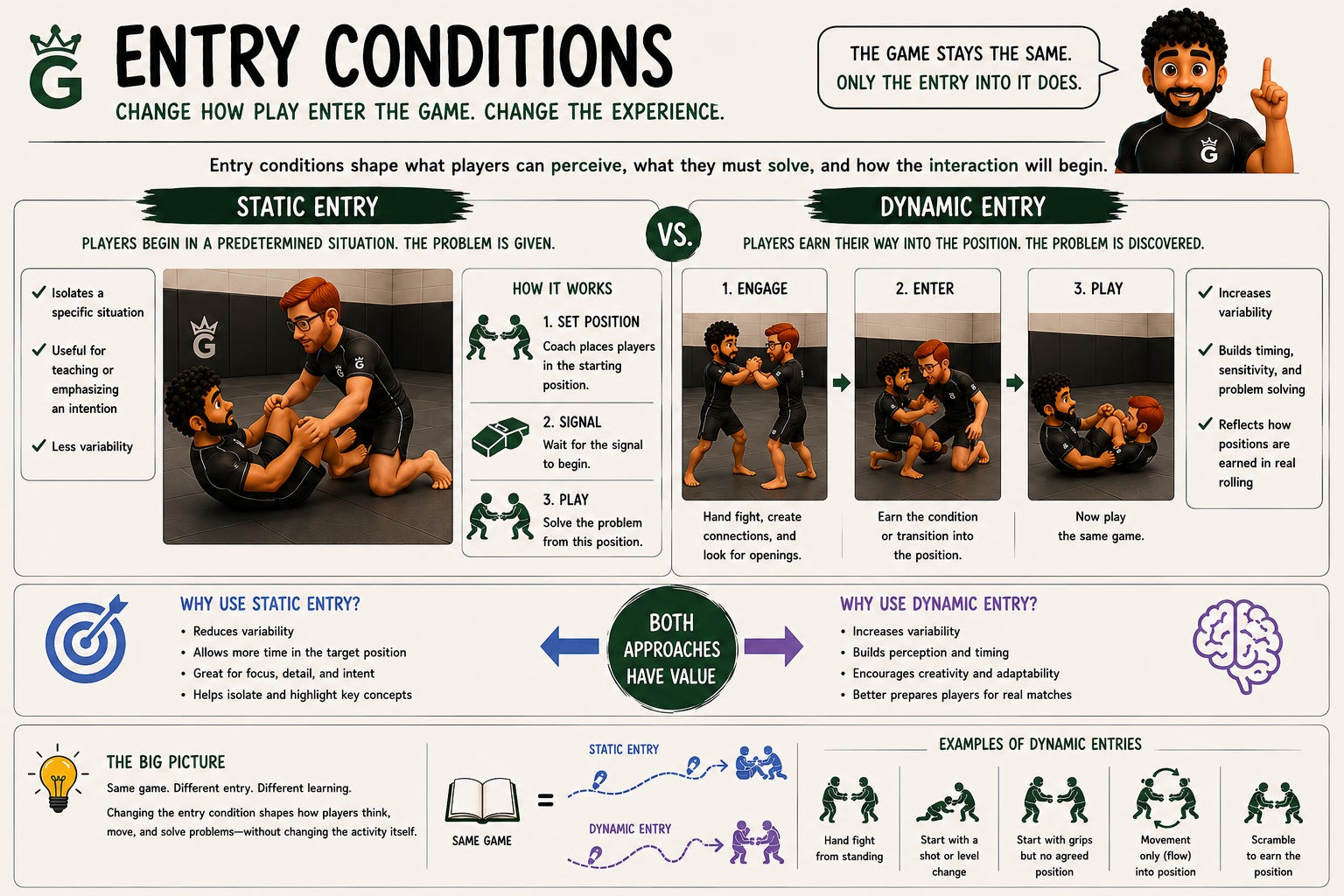
Both approaches have value.
Static starts reduce variability and allow players to spend more time exploring a particular interaction. Dynamic starts increase variability by requiring players to perceive opportunities, establish meaningful conditions, and transition naturally into the activity.
The game itself doesn't change. Only the entry into it does.
5. Build Systems, Not Sessions
When I first began incorporating concepts of ecological dynamics and CLA, I thought every practice needed to be different.
I was constantly creating new games, new progressions, and new activities because I assumed novelty was the key to representative learning.
Over time, I realized I had the problem backwards.
The goal isn’t to create a new practice every day. The goal is to build a system that makes designing practices a less daunting task.
Once I began thinking in terms of modular activity blocks, repeatable practice structures, and the major moments of submission grappling, practice planning became less about inventing something new and more about making intentional decisions.
Instead of asking:
“What should we do today?”
I began asking:
Which intention deserves emphasis?
Which major moments support that intention?
Which practice structure best fits today’s objective?
How can I introduce variability through pairings, reset conditions, and dynamic entries into the game?
The underlying architecture rarely changes. The experience inside it changes constantly.
Ironically, having more structure gave me more freedom. Rather than spending my energy inventing new activities, I could spend it observing players, adjusting constraints, and responding to the problems that emerged during practice.
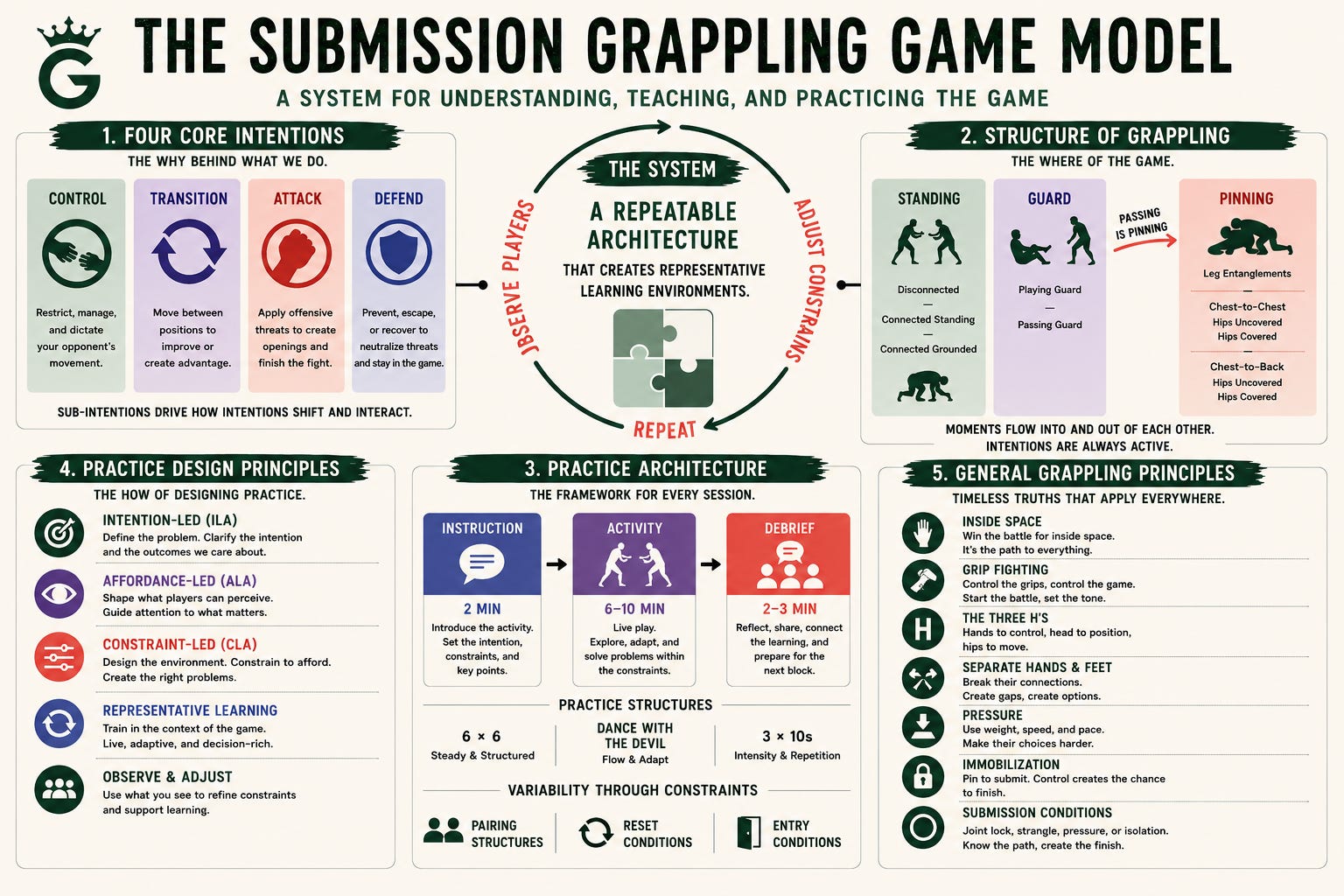
The result isn’t a collection of sessions.
It’s a coaching system. I still design every individual practice, but I no longer start with a blank page. The architecture already exists. Each practice simply becomes another expression of the same underlying system.
Acknowledgments
While I’ve mentioned Greg Souders throughout this article because of the significant influence he’s had on me and so many others, these ideas weren’t developed in isolation.
Over the past several years, the daily discussions within the ED4SG Discord community and the coaches who have attended our camps have challenged my assumptions, asked difficult questions, shared new perspectives, and tested many of these ideas in their own academies. This framework is as much a product of those conversations as it is of my own experiences on the mat.
Many of the ideas in this article became clearer not because someone gave me the answer, but because someone asked a better question. That’s what this community has always been at its best—a place where ideas are challenged, refined, tested, and shared openly.
To everyone who has contributed—whether by asking a thoughtful question, offering a different perspective, or sharing what has and hasn’t worked in your own coaching—thank you. This work is better because of your curiosity, generosity, and willingness to experiment.
I hope these ideas don’t become something to copy, but something to build upon. My goal has never been to provide the final answer—only to contribute to an ongoing conversation about how we can become better coaches.